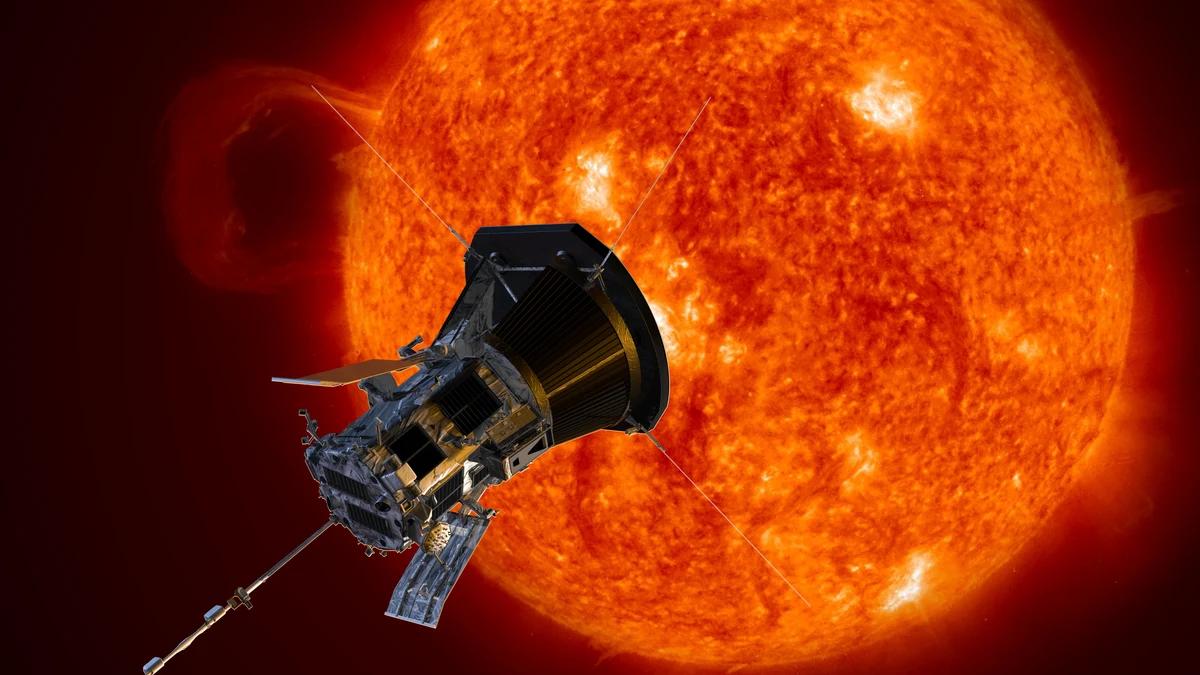
Astrophysicists analyzing high-cadence telemetry from NASA's Parker Solar Probe announced a major breakthrough on November 11, revealing that turbulent magnetic fields swirling inside the sun's superheated corona unexpectedly reverse their direction of rotation at microscopic plasma scales. The findings resolve a decades-old puzzle regarding how solar wind accelerates to supersonic speeds and transfers thermal energy across the inner heliosphere.
Since becoming the first human-made spacecraft to plunge directly through the sun's outer atmosphere, Parker Solar Probe has survived temperatures exceeding thousands of degrees behind its carbon-composite heat shield to sample magnetic waves at close range. Researchers found that rather than cascading smoothly downward from large magnetic eddies into uniform heat, plasma fluctuations undergo sharp rotational inversions—known as helicity reversals—at kinetic ion and electron thresholds.
Transforming Space Weather Forecasting for Satellites and Grids
Understanding this micro-scale magnetic behavior carries immediate practical value for modern technological infrastructure on Earth. Coronal mass ejections and fast solar wind streams regularly buffet Earth's magnetosphere, threatening low-Earth-orbit communications constellations, GPS timing accuracy, high-latitude aviation routes, and bulk electric power transformers.
By incorporating the newly observed rotational reversal mechanics into magnetohydrodynamic computer models, space weather forecasters at NOAA and NASA expect to improve lead-time accuracy for severe geomagnetic storm warnings. Better predictive precision allows satellite operators to place sensitive instruments into safe mode and enables grid managers to rebalance reactive power reserves before geomagnetic induced currents strike.
Voyager 1 Nears Historic One Light-Day Milestone
The Parker Solar Probe discovery highlights a landmark November for NASA deep-space operations. Mission engineers at the Jet Propulsion Laboratory are simultaneously preparing to commemorate a historic milestone on November 18, when the iconic Voyager 1 spacecraft—launched nearly half a century ago in 1977—will reach exactly one full light-day away from Earth, roughly 16.094 billion miles into interstellar space. At that distance, round-trip light-speed radio commands require forty-eight hours to travel between Goldstone Deep Space Network dishes and the aging probe.
Closer to the inner solar system, NASA's twin ESCAPADE spacecraft recently completed successful powered Earth flyby maneuvers, locking onto an interplanetary trajectory scheduled to enter Martian orbit in September 2027 to study how solar winds stripped away the Red Planet's ancient atmosphere.