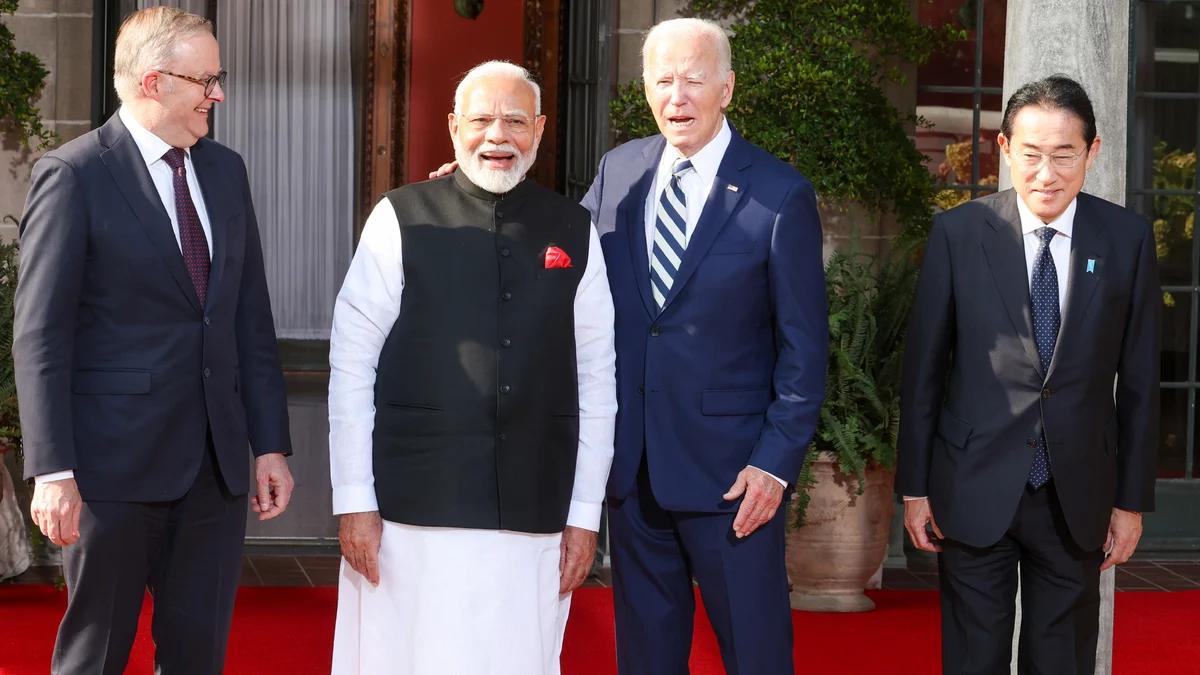
Gathering on the sidelines of the expanded Asian diplomatic conferences in Manila on Wednesday, the heads of state of the Quadrilateral Security Dialogue—United States President Donald Trump, Indian Prime Minister Narendra Modi, Australian Prime Minister Anthony Albanese, and Japanese Prime Minister Sanae Takaichi—reaffirmed their binding commitment to a "free, open, and rules-based Indo-Pacific," unveiling unprecedented joint defense mechanisms to deter maritime intimidation across critical sea routes.
The joint summit communiqué, titled the *Manila Maritime Accord of 2026*, marks a substantial escalation from rhetorical diplomatic alignment to concrete operational defense integration among the four democratic powers.
Unified Coast Guard Interoperability and Real-Time Surveillance
The central pillar of the agreement establishes the Quad Maritime Domain Awareness (MDA) Grid, an integrated satellite and maritime patrol network that will synthesize data from Indian Ocean acoustic monitors, Japanese radar installations, Australian maritime patrol aircraft, and U.S. naval reconnaissance assets.
Crucially, the four leaders announced the launch of the *Quad-At-Sea Shiprider Agreement*, permitting coast guard and maritime enforcement officers from all four member nations to embed aboard one another's vessels during joint maritime patrols through international waters in the South China Sea, the Luzon Strait, and the Malacca Straits. The program aims to confront unregulated fishing fleets, illicit maritime militias, and unilateral attempts to alter established maritime boundaries by physical force.
"We stand united in our resolve that international law, freedom of unimpeded navigation, and sovereign rights must never yield to coercive economic or military pressure," President Trump declared during the joint press appearance. "Peace through strength is not an abstraction; it is the physical presence of allied democratic navies guaranteeing that global trade routes remain open to all nations."
Critical Infrastructure and Subsea Telecom Cable Security
Prime Minister Modi and Prime Minister Takaichi emphasized that maritime stability encompasses underwater critical infrastructure. The Quad leaders formalized a $4.8 billion joint investment mechanism to finance redundant undersea telecommunications cables connecting Southeast Asian island chains to secure landing hubs in India, Australia, and Japan.
Australian Prime Minister Albanese highlighted the initiative as an economic and national security imperative, noting that malicious interdiction of commercial subsea cables could sever global financial clearinghouses in milliseconds. Regional security analysts view the Manila accord as the most consequential solidification of the Quad's defense footprint since its revitalization, sending a resounding signal of allied deterrence across the Western Pacific.