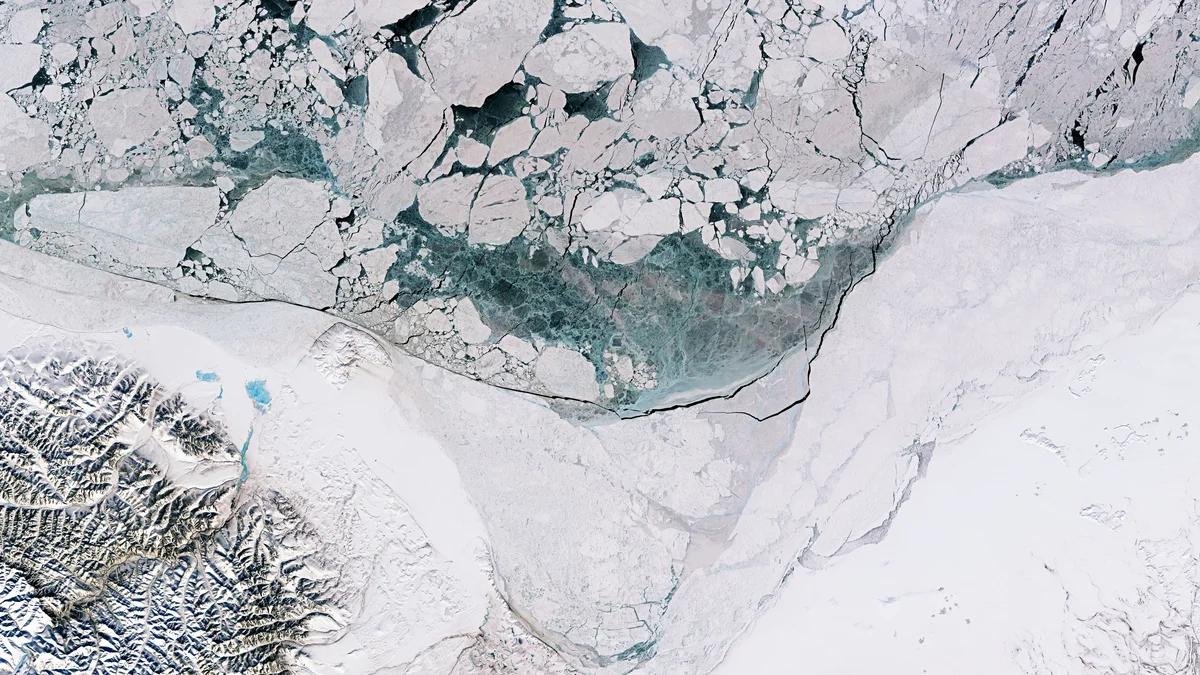
The National Oceanic and Atmospheric Administration (NOAA), in collaboration with polar research institutions across Canada, Norway, and Greenland, released its authoritative annual Arctic Winter Climate Assessment on Friday. The peer-reviewed scientific report presents a highly sophisticated, multi-dimensional diagnostic of cryospheric transformations across the high latitudes, documenting unprecedented structural shifts in polar jet stream stability alongside localized multi-year sea ice resilience across the Beaufort and Chukchi Seas.
The Shifting Geometry of the Polar Vortex
The defining headline of the 2026 assessment is the increasing destabilization and meridional waviness of the northern polar stratospheric vortex. Historically, the circumpolar jet stream maintained a tight, zonal circular boundary around the Arctic circle, trapping frigid air masses above seventy degrees north latitude. However, high-altitude atmospheric sounding profiles and satellite radar altimetry collected over the past eighteen months reveal that persistent Arctic amplification has severely weakened this thermal gradient.
As the temperature differential between equatorial regions and the Arctic narrows, the jet stream increasingly develops elongated, meandering planetary Rossby waves. These structural undulations create recurrent "polar plunge" episodes that drive deep sub-freezing Arctic air into temperate mid-latitudes across North America and Western Europe, while simultaneously pumping anomalous warm oceanic air deep into the central Arctic Basin.
Regional Multi-Year Ice Anomalies in the Western Arctic
While the overall Pan-Arctic sea ice volume remains approximately thirty-five percent below late-twentieth-century historical averages, the 2026 report documented a scientifically intriguing divergence in the Western Arctic. Thanks to persistent anticyclonic wind patterns that anchored the Beaufort Gyre over the preceding winter, multi-year sea ice pack thickness in the northern Chukchi and Beaufort seas expanded by an unexpected 8.5 percent compared to 2024 baselines.
"What we are observing is an Arctic climate system characterized not by uniform linear decline, but by extreme localized volatility and complex thermodynamic feedback loops," stated Dr. Rick Spinrad, NOAA Administrator, during a scientific symposium at the National Snow and Ice Data Center (NSIDC) in Boulder, Colorado. "While localized multi-year ice recovery in select western sectors provides critical temporary thermal insulation, the broader baseline trend of maritime warming and early seasonal snowpack melt remains overwhelmingly evident across the eastern Greenland and Barents Sea corridors."
Marine Ecosystem Impacts and Indigenous Community Observations
The assessment incorporates detailed ethnographic and observational data from forty-six Arctic Indigenous communities across Alaska's North Slope, Nunavut, and northern Fennoscandia. Indigenous elders and subsistence hunters noted that shifting shorefast ice formations have fundamentally disrupted traditional migratory corridors for bowhead whales, ringed seals, and Pacific walrus populations.
Simultaneously, oceanic research vessels operating along the ice margins confirmed unprecedented blooms of sub-surface phytoplankton beneath thinning seasonal ice sheets. The expansion of these sub-ice algal blooms is drawing southern boreal fish species—including Atlantic cod and capelin—deeper into traditionally high-Arctic waters, triggering rapid restructuring of marine trophic food webs and intensifying international geopolitical competition over newly accessible Arctic maritime navigation routes.
Global Implications for Mid-Latitude Winter Forecasting
NOAA's climate modelers emphasized that the assessment's findings carry urgent implications for municipal preparedness and energy planning across the continental United States. The heightened probability of sudden stratospheric warming events (SSW) linked to the fractured jet stream geometry indicates that North America faces an elevated risk of severe, clustered winter freeze events during January and February 2027.
The report concludes with an urgent call for international expansion of autonomous polar ocean observation arrays, stressing that understanding Arctic cryospheric mechanics is no longer merely an ecological curiosity, but an essential prerequisite for global food security, coastal infrastructure protection, and civil climate resilience.