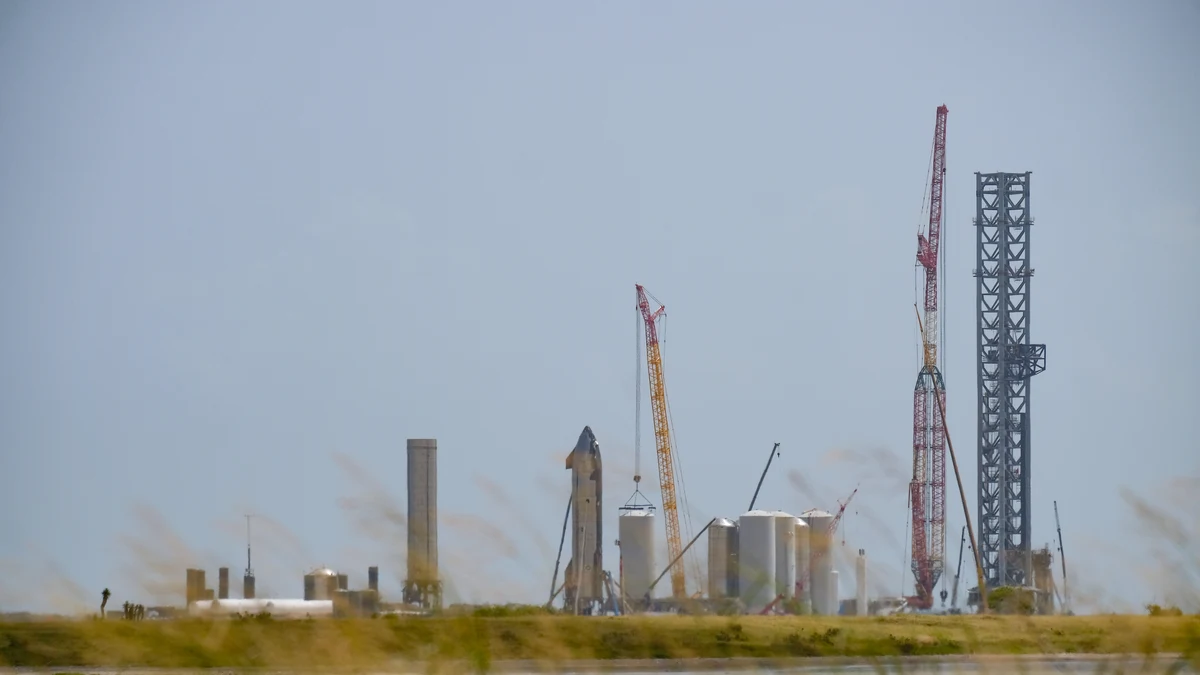
Rupturing the early morning skies along the South Texas coastline with thirty-three Raptor engines generating a staggering sixteen million pounds of thrust, SpaceX launched its milestone fifteenth Starship integrated test flight from the Starbase spaceport in Boca Chica on Saturday, marking another historic leap forward for fully reusable orbital rocketry.
Flight 15 represents the culmination of aggressive hardware iterations and aerodynamic refinement. Following nominal staging at an altitude of approximately seventy kilometers, the Super Heavy booster executed an immaculate flip-and-boostback maneuver, successfully navigating through supersonic atmospheric re-entry over the Gulf of Mexico toward the launch facility's monumental "Mechazilla" integration tower.
Chopstick Tower Catch Maneuver and Orbital Insertion
Flight controllers cheered as the colossal seventy-one-meter-tall booster decelerated rapidly using its center cluster of gimbaling Raptor engines, hovering precisely between the launch tower's massive mechanical "chopstick" capture arms before engines shut down and the booster was brought to rest safely above the launch mount. The audacious catch maneuver marks another successful demonstration of rapid booster reusability without sacrificial landing legs.
Meanwhile, the Starship upper stage continued powered ascent into a nominal low-Earth orbital trajectory, achieving targeted velocity milestones and successfully demonstrating the in-space relight of a single vacuum Raptor engine. Mission payloads included a suite of secondary communications satellite deployment simulators and internal propellant transfer monitors designed to validate cryogenic orbital refueling techniques essential for NASA's Artemis lunar landing program.
"Full and rapid reusability is the fundamental breakthrough needed to make life multiplanetary," SpaceX founder Elon Musk broadcasted following the launch. "Flight 15 validated our thermal protection tile upgrades and demonstrated that catching giant rockets is now a repeatable engineering reality."
Paving the Way for Artemis Lunar Landings and Mars Missions
NASA officials monitoring the test from Johnson Space Center in Houston expressed high satisfaction with Flight 15's telemetry. Under NASA's Artemis III and IV contracts, a modified Starship Human Landing System (HLS) is slated to ferry American astronauts from lunar orbit down to the South Pole of the Moon.
The successful execution of orbital insertion, cryogenic propellant monitoring, and booster recovery eliminates critical technical bottlenecks facing commercial lunar architecture. SpaceX engineers announced that data captured during Saturday's flight will be incorporated into the upcoming Starship V3 production line, which features lengthened propellant tanks, upgraded high-efficiency Raptor 3 powerplants, and expanded payload fairing capacities.