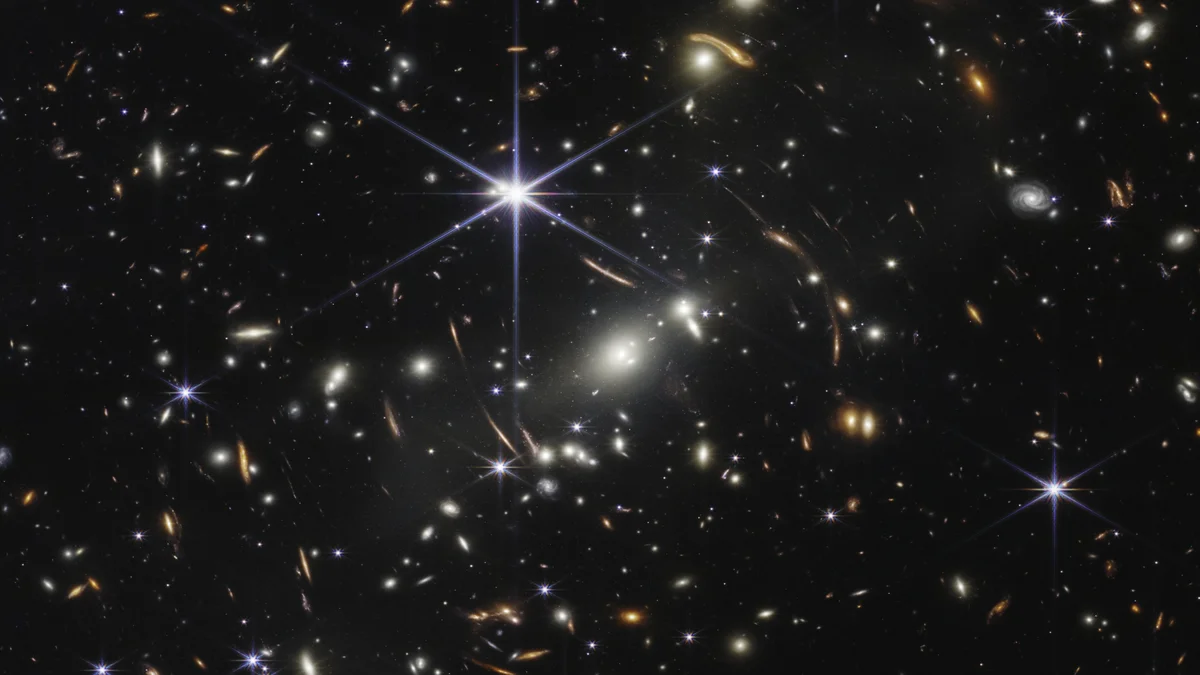
In a groundbreaking dual-observatory discovery published on Friday in the journal Nature Astronomy, an international team of astrophysicists utilizing coordinated deep-space spectroscopic observations from NASA's James Webb Space Telescope (JWST) and the newly commissioned Nancy Grace Roman Space Telescope confirmed the detection of six massive, chemically pristine primordial galaxies that coalesced just 320 million years after the Big Bang.
Challenging the Standard Cosmological Framework
The newly identified cosmic structures, observed at unprecedented spectroscopic redshifts exceeding z=14.2, represent the earliest directly confirmed galactic assemblies in human astronomical history. Under long-standing standard cosmological models (Lambda-CDM), the nascent universe during this epoch—known as the Cosmic Dawn—was hypothesized to host only sparse, diffuse molecular clouds and low-mass protostellar clusters slowly emerging from the cosmic dark ages.
However, high-resolution infrared spectrographic analysis revealed that these ancient galaxies boast stellar masses exceeding ten billion solar masses—magnitudes nearly one hundred times larger than theoretical models predicted could possibly aggregate in the first few hundred million years of cosmic time. Furthermore, data collected across multiple near-infrared filter arrays demonstrated an almost total absence of "metals" (elements heavier than hydrogen and helium), confirming that their immense luminosity is driven by Population III hyper-massive stars that burned with millions of times the radiance of our Sun.
The Power of Synchronized Space Observatories
"Seeing galaxies of this structural maturity and stellar mass density so close to the beginning of time is like unearthing the fossilized skeleton of a fully grown mastodon in a geological stratum where we only expected single-celled organisms," explained lead author Dr. Althea Thorne of the Space Telescope Science Institute (STScI) in Baltimore. "The combination of Roman's panoramic wide-field survey capabilities and Webb's unmatched infrared spectroscopic resolution allowed us to pinpoint and confirm these elusive cosmic beacons with irrefutable fidelity."
The discovery was made possible by Roman's initial Deep Field High-Latitude Survey, which surveyed an expanse of sky fifty times larger than Webb's core observation swath in a fraction of the time. Once Roman's automated anomaly-detection algorithms flagged the hyper-redshift candidates, mission controllers pivoted Webb's Near-Infrared Spectrograph (NIRSpec) to conduct continuous 48-hour spectroscopic integrations, capturing distinct Lyman-break spectral signatures that verified their extraordinary distances beyond any scientific doubt.
Implications for Dark Matter and Supermassive Black Holes
Beyond revising timelines for the Epoch of Reionization, the findings provide vital new empirical clues regarding the elusive origins of supermassive black holes. Spectroscopy of two of the six galaxies revealed intense X-ray emissions and anomalous velocity dispersions at their galactic cores, strongly suggesting the presence of "direct-collapse" black hole seeds containing hundreds of thousands of solar masses at birth, bypassing intermediate stellar remnants entirely.
Theoretical cosmologists at Princeton, Cambridge, and the Max Planck Institute for Astrophysics have already initiated revised hydrodynamic simulations to examine whether primordial dark matter density fluctuations were substantially more energetic than previously estimated. As joint Webb-Roman survey campaigns continue throughout 2027, astronomers anticipate uncovering dozens of additional Cosmic Dawn systems, permanently rewriting humanity's understanding of how the living universe assembled its earliest structures.