Swiss Franc Hits Decade High as Investors Seek Safe Haven
The Swiss franc climbed to its strongest level in a decade as global investors shifted into safe-haven assets amid currency volatility and policy uncertainty.
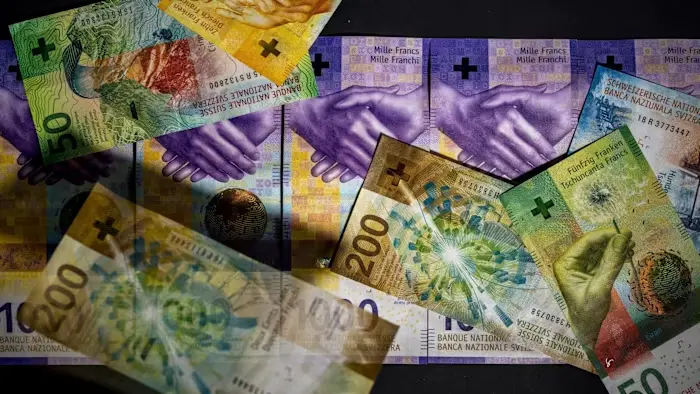
As economic uncertainty and currency volatility engulf financial markets, investors around the world are increasingly turning to safe-haven assets, as evidenced by the Swiss franc's ascent to its highest level in over ten years. As policymakers provide conflicting signals on inflation, interest rates, and fiscal stability, trading desks are becoming more cautious. During the most recent trading sessions, the franc was in high demand on currency markets as investors favored Switzerland's standing as a politically neutral, fiscally responsible, and financially stable country. As confidence in a number of major currencies declined, especially in light of worries about policy legitimacy and weakening global growth, analysts saw that flows into the franc surged. Behind-the-Rally Drivers Market participants attribute the franc's surge to a confluence of factors, including unstable market sentiment, unknown monetary policy paths, and geopolitical uncertainty. Investors have increasingly resorted to currencies that are seen as reliable stores of value due to regional variations in inflation trends and central banks' indications of varying schedules for rate changes. The recent spike further solidifies the Swiss franc's position as a defensive asset, which has historically profited during times of stress. In an effort to lessen exposure to risk-sensitive currencies, traders observed an uptick in purchases from institutional investors, such as asset managers and pension funds. Effect on International Currency Markets The strengthening of the franc coincided with more significant changes in the foreign exchange markets. Uncertainty around policy has put pressure on the US dollar, while inconsistent economic data has made it difficult for the euro and yen to sustain their gains. In light of this, the franc has become the go-to option for protecting capital. As a result of capital flight from higher-yielding assets due to risk aversion, emerging market currencies were also affected. Sustained franc strength might increase volatility in international currency markets, analysts said, especially if investor mood continues to decline. Focus on the Swiss National Bank Since a stronger currency might hinder exports and economic growth, the Swiss National Bank (SNB) is keeping a careful eye on the franc's increase. Although the SNB has taken action in the past to stop excessive appreciation, decision-makers have not yet indicated that they will take urgent action. Economists point out that the SNB must strike a careful balance. A strong franc, on the one hand, aids in containing inflation from imports. However, sustained strength can be detrimental to Switzerland's export-oriented economy. Any hint of policy change or intervention could have an immediate impact on the direction of the market. Wider Market Consequences Gains in other conventional safe havens, such as gold and premium government bonds, coincided with the rise in the Swiss franc. As investors struck a balance between protective stance and selective risk-taking, equity markets displayed a range of performance. The action signals a more comprehensive reevaluation of risk for international investors. Even while economic growth hasn't stopped, portfolio strategies are nevertheless influenced by geopolitical developments, inflation, and policy decision uncertainty. Considering the Future The destiny of the franc, according to currency analysts, will depend on future economic data, communications from central banks, and shifts in the perception of global risk. The franc may continue to be in demand if uncertainty stays high. The allure of safe-haven assets might be diminished, though, by any indications of stabilization or unified policy clarity. For the time being, investor caution is evident from the franc's rise to a ten-year high. As they negotiate an increasingly complicated global economic environment, markets seem to be taking a defensive stance and putting stability over yield.




Daniel Morris is an investigative journalist covering politics, finance, and corporate accountability. His reporting emphasizes fact-checking, transparency, and long-form analysis. Daniel,s work aims to provide readers with context beyond the headlines.
WHAT'S HOT



CATEGORIES

Business
7 Articles

Finance
9 Articles

Technology
14 Articles

Politics
7 Articles

Lifestyle
7 Articles